LONDON (Reuters) - burst to its highest level in almost five months on Tuesday, sending smaller cryptocurrencies up, with analysts ascribing the move to a major order by an anonymous buyer that triggered a frenzy of computer-driven trading.
The original and biggest cryptocurrency soared as much as 20 percent in Asian trading, surpassing $5,000 for the first time since mid-November. By mid-morning, it had settled at around $4,800, still up 16 percent in its biggest one-day gain since April last year.
Bitcoin surged to near $20,000 in late 2017, the peak of a bubble driven by retail investors that pushed cryptocurrencies onto the agenda of mainstream financial firms. But wide interest waned as prices collapsed, and now trading is mostly powered by smaller hedge funds, tech firms and wealthy individuals.
Oliver von Landsberg-Sadie, chief executive of London-based cryptocurrency firm BCB Group, said the move was likely triggered by an algorithmic order worth about $100 million spread across major exchanges - U.S.-based Coinbase and Kraken, and Luxembourg-based Bitstamp.
"There has been a single order that has been algorithmically-managed across these three venues, of around 20,000 BTC," he said.
"If you look at the volumes on each of those three exchanges – there were in-concert, synchronized, units of volume of around 7,000 BTC in an hour".
For a graphic on Bitcoin price, see - https://tmsnrt.rs/2VadrPe
Outsized price moves of the kind rarely seen in traditional markets are still common in cryptocurrency markets, where liquidity is thin and prices highly opaque.
So orders of large magnitude tend to spark buying by algorithmic traders, said Charlie Hayter, founder of industry website CryptoCompare.
As bitcoin surged, there were 6 million trades over an hour, Hayter said - three to four times the usual amount, with orders concentrated on Asian-based exchanges.
"You trigger other order books to play catch up, and that creates a buying frenzy."
Bitcoin's surge sent smaller cryptocurrencies, known as "altcoins," trading higher. Ethereum's ether and Ripple's , respectively the second- and third-largest coins, both jumped by more than 10 percent.
Price moves of smaller coins tend to be correlated to bitcoin, which still accounts for just over half of the value of the cryptocurrency market.
"Usually bitcoin is the leader of the market and altcoins tend to follow, as far as direction and sentiment is concerned," said Mati Greenspan, an analyst at e-Toro in Israel. "Today bitcoin is in the driving seat."
Cryptocurrency markets have been relatively calm so far this year, with bitcoin trading until today between around $3,300 and $4,200.
There have been few catalysts for big price moves of the kind seen last year. In 2018, fears of regulatory clampdowns and declining interest from retail investors saw bitcoin slump by about three-quarters.
LONDON (Reuters) - burst to its highest level in almost five months on Tuesday, sending smaller cryptocurrencies up, with analysts ascribing the move to a major order by an anonymous buyer that triggered a frenzy of computer-driven trading.
The original and biggest cryptocurrency soared as much as 20 percent in Asian trading, surpassing $5,000 for the first time since mid-November. By late morning, it had settled at around $4,700, still up 15 percent in its biggest one-day gain since April last year.
Bitcoin surged to near $20,000 in late 2017, the peak of a bubble driven by retail investors that pushed cryptocurrencies onto the agenda of mainstream financial firms. But wide interest waned as prices collapsed, and now trading is mostly powered by smaller hedge funds, tech firms and wealthy individuals.
Oliver von Landsberg-Sadie, chief executive of London-based cryptocurrency firm BCB Group, said the move was likely triggered by an algorithmic order worth about $100 million spread across major exchanges - U.S.-based Coinbase and Kraken, and Luxembourg-based Bitstamp.
"There has been a single order that has been algorithmically-managed across these three venues, of around 20,000 BTC," he said.
"If you look at the volumes on each of those three exchanges – there were in-concert, synchronized, units of volume of around 7,000 BTC in an hour".
For a graphic on Bitcoin price, see - https://tmsnrt.rs/2VadrPe
Analysts could not point to any specific news or developments in the cryptocurrency sector that could explain the mystery buyer's big order.
Outsized price moves of the kind rarely seen in traditional markets are common in cryptocurrency markets, where liquidity is thin and prices highly opaque.
So orders of large magnitude tend to spark buying by algorithmic traders, said Charlie Hayter, founder of industry website CryptoCompare.
As bitcoin surged, there were 6 million trades over an hour, Hayter said - three to four times the usual amount, with orders concentrated on Asian-based exchanges.
"You trigger other order books to play catch up, and that creates a buying frenzy."
Bitcoin's surge sent smaller cryptocurrencies, known as "altcoins," trading higher. Ethereum's ether and Ripple's , respectively the second- and third-largest coins, both jumped by more than 10 percent.
Price moves of smaller coins tend to be correlated to bitcoin, which still accounts for just over half of the value of the cryptocurrency market.
"Usually bitcoin is the leader of the market and altcoins tend to follow, as far as direction and sentiment is concerned," said Mati Greenspan, an analyst at eToro in Israel. "Today bitcoin is in the driving seat."
Cryptocurrency markets have been relatively calm so far this year, with bitcoin trading until today between around $3,300 and $4,200.
There have been few catalysts for big price moves of the kind seen last year. In 2018, fears of regulatory clampdowns and declining interest from retail investors saw bitcoin slump by about three-quarters.
Singapore Airlines Ltd. found “premature blade deterioration” on some engines during routine inspections, leading the carrier to ground two Boeing Co. 787-10 ...
View full coverage on Google News
https://www.bloomberg.com/news/articles/2019-04-02/singapore-air-grounds-two-planes-on-rolls-royce-engine-issue-jtzf5ex1
SAN FRANCISCO — Lyft’s debut on the stock market is off to a bumpy start.
The ride-hailing company went public in a blaze of glory on Friday, as its stock jumped 8.7 percent from its initial public offering price of $72 a share. On Monday, in its second day of trading, Lyft’s stock plunged nearly 12 percent to below $72, closing the day at $69.01.
The rapid decline raises questions about investors’ appetite for fast-growing but unprofitable tech companies. While Lyft has been expanding and gaining new revenue, it lost nearly $1 billion last year. Ride-hailing companies often subsidize the cost of rides and pay incentives to drivers, which is expensive. And Lyft is also spending heavily on initiatives including electric bikes and self-driving technology.
Other tech companies that went public while recording large losses, such as Snap, Twitter and Groupon, also eventually fell below their offering prices.
“Everyone is taken up with the idea of the ride-hailing business; it’s exciting and high-growth,” said Kathleen Smith, a principal at Renaissance Capital, which manages an I.P.O.-focused exchange-traded fund that will include Lyft later this week. “But it’s hard to figure out their valuation.”
Lyft’s performance could sway other high-profile tech companies that are planning to go public.
Uber, the world’s biggest ride-hailing company, is planning to go public in the next few months; it is also deeply unprofitable. Others are also stampeding toward the public market, including: Pinterest, the digital pin board; Slack, the messaging company; and Peloton, the home-fitness company.
“The ones following in the wake of Lyft will be priced more reasonably,” Ms. Smith said.
Even if Lyft eventually makes money, its margins might be low, she cautioned. Lyft is constantly dealing with new competitors, which means that it may have to continue subsidizing its drivers and cutting the prices that it charges passengers. That makes profits a faraway prospect.
The volatility in Lyft’s stock was not unexpected, said Tom White, a senior vice president at the wealth management firm D.A. Davidson. “Nothing has changed on the fundamental outlook for the business in the last few days,” he said.
Amazon is once again cutting prices at Whole Foods Market.
Amazon and Whole Foods are enacting the third round since Amazon purchased the specialty organic grocer in June 2017. The latest round of cuts comes amid intense competition in the grocery sector and the high-price image that still continues to plague Whole Foods. Customers will save an average of 20% on the new reduced priced items.
In addition to new lower prices on hundreds of items that start for all shoppers on Wednesday, April 3, Prime members will now have double the number of exclusive weekly Prime member deals and deeper discounts. Over the next few months, Whole Foods said it will roll out more than 300 Prime member deals on popular seasonal items.
“Whole Foods Market continues to maintain the high quality standards that we’ve championed for nearly 40 years and, with Amazon, we will lower more prices in the future, building on the positive momentum from previous price investments,” said John Mackey, Whole Foods Market co-founder and CEO. “We will continue to focus on both lowering prices and bringing customers the quality they trust and the innovative assortment they expect from our brand.”
Examples of exclusive Prime member deals in April that will rotate on a weekly basis include organic asparagus, organic strawberries, and spiral sliced ham. Prime members can also receive an additional 10% off hundreds of sale items throughout the store.
These price reductions will build on hundreds of lower prices that have been introduced to customers since the Amazon and Whole Foods Market merger, according to Whole Foods.
Starting Wednesday through the end of April, customers who try Prime can get $10 off their $20 purchase in-store at Whole Foods Market. New members can try Prime free for 30 days.
Since Whole Foods Market joined Amazon the companies have launched exclusive Prime member savings, as well as two-hour delivery on Whole Foods groceries for Prime members in 60 metro areas, grocery pickup in as little as 30-minutes at select Whole Foods Market locations, shopping via the Alexa voice-activated digital assistant, and Amazon Lockers in Whole Foods Market stores.
The Impossible Burger is coming to Burger King as the Impossible Whopper, in a market test that could lead to the largest restaurant industry embrace yet of a plant-based meat substitute.
The Impossible Whopper will feature the same bun, cheese and condiments as a traditional Whopper, but with Impossible's plant-based patty where animal meat is normally found. Fifty-nine Burger King stores in the St. Louis area will offer it as of April 1, with a potential expansion to the other 7,100 US restaurants later in the year.
While the partnership is debuting on April Fools' Day, it's no joke. Burger King is making an unusually high-profile endorsement of plant-based meat, while Impossible is facing its own Tesla Model 3 moment in terms of going mainstream.
Now playing:Watch this:
See the technology behind Burger's King's new burger
7:19
I got a jump on the debut when I arrived at Impossible's Silicon Valley headquarters carrying two bags of Whoppers from the local Burger King. There, J. Michael Melton, Impossible's technical sales and culinary manager, cooked up a batch of the patties they're supplying to Burger King, using the same broiler Burger King uses. He swapped them in for the beef in the Whoppers (with professional dexterity that somehow left the burgers appealing) and I took a couple bites.
The remarkable thing was how unremarkable they were: Nothing gives away the fact that this Whopper contains a different main ingredient.
The patties supplied to Burger King will be based on Impossible's new 2.0 formulation that was announced at CES in January, 2019. Among other upgrades, this formulation holds up better in restaurant environments like hot holding trays or the 6-inch drop at the end of the conveyor that grills the patty for exactly 2 minutes and 35 seconds at 630 degrees.
"We're making meat from plants. That's never been done before," Impossible Foods founder Pat Brown told me, tacitly demoting competitor Beyond Meat's plant-based burger. "People have made plant-based replacements for meat, but they haven't made plant-based meat."
On the left is the Impossible Whopper we hacked in Impossible's test kitchen. On the right, a traditional Whopper, indistinguishable visually and on the palate.
Brian Cooley/CNET
One way the Impossible Whopper will indeed differ from the original is price, costing a significant dollar more in an industry where brands have gone to war brandishing menus of items that only cost a dollar. As with electric cars, price parity with the established choice is a future linchpin to mainstream success.
"Once we have products that taste the same or better and that cost less, plant-based and clean meat will simply take over," according to Bruce Friedrich, executive director of the Good Food Institute, which champions plant- and cell-based meats. "So very little will change in people's everyday lives as more and more meat is produced either from plants or from cells. Consumers will continue to buy burgers, chicken sandwiches, and sausages (but) those products will simply not have the adverse impact on our environment and global health."
Impossible says its team spent an inordinate amount of time getting its burger to survive the "death-defying drop" at the end of the broiler-conveyor without breaking apart.
Brian Cooley/CNET
Burger King doesn't break out sales figures for Whoppers, let alone its expectations for the more expensive Impossible Whopper, but some insights can be inferred from a 2018 survey by Faunalytics. Assuming price was no different between beef and alternative burgers, 65 percent of consumers polled said they would still stick with beef, 21 percent would choose a plant-based burger like Impossible, and 11 percent would select a cultured burger grown from animal cells, which isn't expected on the market until the early 2020s.
But Impossible's Pat Brown feels such surveys leave out the qualitative experience. "If you give them our burger, and then ask them the question again, a very large majority of them say they would definitely buy it and would be willing to pay a premium for it."
A case of Impossible Whopper patties, the result of a long effort to comport to the realities of the fast food industry, not the other way around.
Brian Cooley/CNET
Acceptance of plant-based meats turns not only on taste, texture and price but on overcoming momentum. Environmental and animal welfare arguments have triggered a million conversations and social media posts about meat's issues, yet US per capita meat consumption hit an all-time high in 2018.
A recent consumer survey also found that concern for personal health handily trumped concern about the environment and animals as a driver of plant-based meat choice. "We need to change the meat, because we aren't going to change human nature," Friedrich said in a recent New York Times profile.
Launching the Impossible Whopper in Missouri, rather than in one of California's crunchy kale enclaves, is jumping right in, given that Missouri is the first state to make it a crime to use the word "meat" to label a product that "is not derived from harvested production livestock or poultry," with up to a $1,000 fine and a year in prison. But the 62-year-old "Whopper" brand is sufficiently synonymous with beefiness that the Impossible version should communicate meatiness without having to use the m-word.
The truly impossible burger is McDonald's Vegetable Deluxe in the UK and other markets. Its two "vegetable goujons" don't even try to emulate beef.
McDonald's
The biggest shoe yet to drop is, of course, McDonald's. With nearly four times the US sales of No. 2 Burger King, few restaurant brands coin more mainstream food trends, yet McDonald's has eschewed both Impossible and Beyond burgers. Instead it offers its own McVegan burger in Finland and Sweden, and the Vegetable Deluxe in the UK. Neither sandwich would likely be mistaken for a hamburger.
And while burgers are the American diet icon, steaks aren't far behind, and an even bigger challenge in alternative meat marketing may soon unfold at fast casual steak chains like Outback or Texas Roadhouse. Unlike burgers, steaks generally arrive on the plate unadorned, without bun, cheese or condiments to mask any shortcomings. Get steak right, so the thinking goes, and the plant-based dominoes begin to fall.
Impossible's Brown says burger R&D has prepared it for the challenge. "I can say, with complete confidence, that we're going to nail it and not only make a great steak, but we're going to make a steak that's as good as anything that ever fell out of a cow."
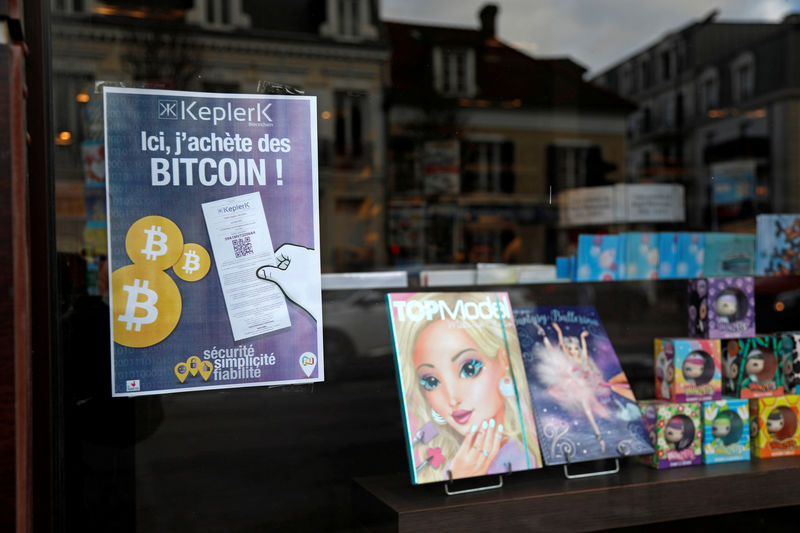 © Reuters. FILE PHOTO: A placard of French startup Keplerk, for clients to purhcase bitcoins, is seen inside a tobacco shop at Rueil-Malmaison


