Kamis, 18 April 2019

T-Mobile's Money banking app makes its nationwide debut - Engadget

T-Mobile's entry into the mobile banking game is now available nationwide, a bit over four months after it first rolled out as a pilot program. The mobile-first checking account is called T-Mobile Money, and it comes with some sweet perks for the carrier's subscribers. It has no fees and offers a four percent Annual Percentage Yield (APY) for users' money up to $3,000 -- everything above that will have a one percent APY -- so long as they sign up with their T-Mobile ID and deposit at least $200 each month.

If users can stick to the required minimum deposit, they can also opt in for the Got Your Back overdraft. That gives them a $50 overdraft protection, so they can withdraw a few more bucks without incurring penalties for when times are especially tough. The app also gives them a way to transfer money, make mobile check deposits, pay bills, send checks and even pay with mobile wallets, including Apple Pay, Google Pay and Samsung Pay.

T-Mobile created the service in partnership with BankMobile, a division of Customers Bank. An account comes with a Mastercard debit card subscribers can use to pay for purchases or for withdrawals at 55,000 Allpoint ATMs worldwide. Anyone interested can use the service either via its official website or its Android and iOS app, which are now available for download from Google Play and Apple App Store, respectively. Residents from any of the 50 US states 18 and older with a social security number can sign up for an account. Later this year, the service will become available to more potential users when it makes its way to Puerto Rico.

T-Mobile

Let's block ads! (Why?)


https://www.engadget.com/2019/04/18/t-mobile-money-nationwide-rollout/

2019-04-18 11:00:01Z
52780271368122

Behind Apple's surprise settlement with Qualcomm - Seeking Alpha

[unable to retrieve full-text content]

  1. Behind Apple's surprise settlement with Qualcomm  Seeking Alpha
  2. Powerful New iPhone Expected After Apple's Embarrassing Surrender  Forbes
  3. Apple had four terrible options to get the iPhone to 5G, so it went with the least of all evils  CNBC
  4. Qualcomm-Apple settlement is surprisingly good for Intel, but it’s bad news for Samsung  MarketWatch
  5. Editorial: The big loser in the Apple - Qualcomm settlement isn't Intel, it's Android  AppleInsider
  6. View full coverage on Google News

https://seekingalpha.com/news/3451766-behind-apples-surprise-settlement-qualcomm

2019-04-18 09:39:00Z
52780267672582

Pinterest IPO; Unilever's healthy boost; Qualcomm soars - CNN

The image bookmarking social network priced its initial public offering at $19 a share on Wednesday, above its original proposed price range of $15 to $17 a share.
Shares will begin trading Thursday on the New York Stock Exchange under the ticker "PINS."
Strong demand may ease investor concerns about the stampede of tech unicorns racing to go public this year after Lyft's lackluster Wall Street debut.
Lyft (LYFT), which debuted on the Nasdaq in late March at $72 per share, has been hammered because worries over its steep losses. Its stock closed at just below $60 a share on Wednesday.
Zoom (ZM), a video conferencing company, will also make its public market debut on Thursday. It has priced its shares at $36, above its original proposed price range.
Unlike most of the other brand name technology companies going public this year, Zoom is profitable and still growing sales fast.
2. Vegan success: Unilever posted stronger than expected first quarter sales growth on Thursday. The owner of brands like Ben and Jerry's and Dove said sales were particularly strong in Asia.
Unilever also highlighted rising demand for healthier and niche food options — such as its new vegan Magnum ice cream.
"Our actions to modernize our portfolio to meet the trends towards authentic, organic and natural, healthy and on-the-go products are working," the company said in a statement.
Analysts have some concerns over the large proportion of revenue growth that came from price increases, rather than sales improvements. Unilever (UL) stock was up more than 2% in London.
Rival consumer goods company Nestle (NSRGF) also reported stronger than expected sales growth on Thursday. Its stock opened 1% higher.
3. Qualcomm soars: Shares in Qualcomm have continued to skyrocket since the chipmaker announced on Tuesday that it had resolved a patent dispute with Apple (AAPL).
Qualcomm (QCOM) will continue charging Apple royalties for its patents, and Apple will pay Qualcomm a substantial fee as part of the agreement.
The stock has soared by 40% to a 5-year high following the announcement.
4. Global market overview: US stock futures were lower ahead of the long weekend. Markets will be closed on Good Friday.
European markets opened mostly lower, following a negative trading session in Asia.
The Dow Jones industrial average closed flat on Wednesday. The S&P 500 dipped 0.2% and the Nasdaq shed 0.1%.
5. Earnings and economics: American Express (AXP), Blackstone (BX), Honeywell (HON), Philip Morris International (PM), Skechers (SKX) and Schlumberger (SLB) will release earnings before the open.
The US Census Bureau will publish retail sales data for March at 8:30 a.m. ET.
6. Coming this week:
ThursdayAmerican Express (AXP), Skechers (SKX) earnings; US retail sales
Friday — US markets are closed

Let's block ads! (Why?)


https://www.cnn.com/2019/04/18/investing/premarket-stocks-trading/index.html

2019-04-18 09:10:00Z
CAIiENtZkuvV7fe667UE5c65a5kqGQgEKhAIACoHCAowocv1CjCSptoCMPrTpgU

Amazon is shutting down its China marketplace business. Here's why it has struggled - CNBC

Queenie Liao, an office worker in Guangzhou, China, shops online several times a week. Alibaba's Taobao and JD.com are her go-to platforms, but it wasn't always that way.

"I used to use Amazon a few years ago. Amazon was one of the first online shops in China and a lot of friends told me that the things from Amazon were much more trustable. That's why I used it," Liao told CNBC. "Taobao and JD have more items now."

Her shift in attitude underscores one of the major reasons why Amazon is thought to be struggling in China. The U.S. e-commerce giant now plans to close its domestic marketplace business in China.

"We are notifying sellers we will no longer operate a marketplace on Amazon.cn and we will no longer be providing seller services on Amazon.cn effective July 18," the company said in a statement, referring to its Chinese-language site, according to the Financial Times.

"Over the past few years, we have been evolving our China online retail business to increasingly emphasize cross-border sales, and in return we've seen very strong response from Chinese customers. Their demand for high-quality, authentic goods from around the world continues to grow rapidly, and given our global presence, Amazon is well-positioned to serve them," the company added.

Customers in China will still be able to buy items from the U.S., Germany, Japan and the U.K. through Amazon's global site as it focused more on cross-border sales into the world's second-largest economy, according to an earlier Reuters report. Amazon's cloud business will reportedly continue to operate in China.

Amazon entered the Chinese market in 2004 through the acquisition of Joyo, a domestic online shopping market. Joyo was rebranded to Amazon China in 2011. It enjoyed success in the early days with market share of over 15 percent in 2011 to 2012, according to China-based analyst Choi Chun of iResearch. That has now plummeted to less than 1 percent, according to another China-based market research firm, Analysys.

As Liao mentioned, Amazon had a reputation in the early days of its China operation for being a site that would have legitimate products and so was trusted by Chinese consumers. Chinese players like Alibaba struggled with policing fake items on their sites. Chinese e-commerce players, however, have been taking proactive measures to fight counterfeit goods.

Not only is Amazon trying to compete with e-commerce giants like JD and Alibaba, who are often able to deliver goods to Chinese customers faster, but smaller domestic like Pinduoduo and VIP.com are also offering a challenge.

The U.S. giant has also not been as aggressive on the marketing front as some of its rivals. Alibaba and JD both do huge sales promotions and big advertising campaigns on Nov.11 each year, known in China as Singles Day.

Amazon said in its statement that it is emphasizing cross-border trade. While that may have been a unique part of the business in the past, China's domestic players have put a big focus on that in recent years. In November, Alibaba announced plans to help global businesses sell $200 billion in goods to China in the next five years. However, analysts said Amazon can still compete for now.

"JD and Alibaba are better positioned because they have larger traffic and consumers trust these two platforms (relatively to other platforms). But one thing I need to point out is that cross-border e-commerce in China is not as consolidated as regular domestic e-commerce, online shoppers go to different platforms for different overseas merchandises," Chun told CNBC. "Therefore, Amazon's cross border e-commerce is still very competitive."

Chun said Amazon's cross-border business is "not insignificant," but the U.S. firm "doesn't realize their problem in the Chinese operation and doesn't want to catch up."

"I don't rule out the possibility that Amazon's cross-border business will follow the same path of Amazon's China domestic e-commerce business," Chun said.

In its statement Amazon said its "commitment to China remains strong."

Let's block ads! (Why?)


https://www.cnbc.com/2019/04/18/amazon-china-marketplace-closing-down-heres-why.html

2019-04-18 07:27:30Z
52780271010943

A goddess inspired a Taiwanese billionaire to follow Trump's example - CNN

Terry Gou, chairman of electronics manufacturing giant Foxconn, said Wednesday that the sea goddess Mazu had told him to "step forward and do something for the people of Taiwan," according to state media.
Gou, who has an estimated net worth of $8 billion, will "withdraw from daily operations" at Foxconn, also known as Hon Hai Precision, if he wins a primary election to be selected as Kuomintang Presidential candidate, according to the company.
Foxconn is the world's largest electronics manufacturer, providing parts for Apple, Huawei and others. The Taiwanese company is hugely involved in China, where it employs hundreds of thousands of people, and in 2017 pledged to build a plant in Wisconsin, in return for $4 billion in state and local tax incentives.
If selected, Gou will likely face off against incumbent Taiwanese President Tsai Ing-wen in the 2020 election, scheduled for January 11.
Tsai announced her intention to run in February this year, after bruising local election losses in 2018 saw her Democratic Progressive Party (DPP) hemorrhaging votes island-wide.
The DPP has traditionally favored moves toward formalizing Taiwan's de facto independence from China. Since she took power in 2016, Tsai has attempted to diversify the island's economy from being too dependent on its large neighbor, while pushing back against what she views as Beijing's aggressive expansionism.
In turn, Beijing has ramped up pressure on Taiwan, conducting large scale military drills around the island, including sailing the Liaoning aircraft carrier through the Taiwan Strait. Speaking in January, Chinese President Xi Jinping urged Taiwan to embrace "peaceful reunification" with China, saying that independence was a "dead end."
Should he become president, Gou will likely be challenged with repairing this relationship, while maintaining Taiwan's traditionally strong ties with Washington.
He will have a better claim than many candidates for being able to do so -- Foxconn has made billions through deep involvement in the Chinese economy, where many of its manufacturing plants are based, producing electronics for many American tech companies, most notably Apple.
Gou himself also has strong ties to the United States, and has met US President Donald Trump, who has called him "a friend of mine" and "one of the most successful businessmen in the world."
The People's Daily, a mouthpiece of the Chinese Communist Party, said on Wednesday that "Gou has a unique advantage in dealing with the relations between Taiwan and Mainland, and the US."
Taiwan will elect its next President on January 11, 2020.
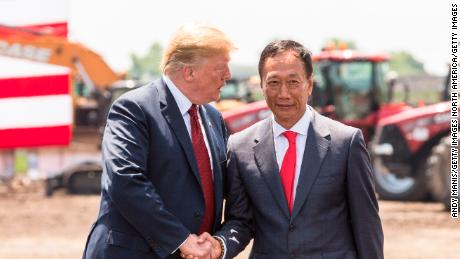
US President Donald Trump shakes hands with Foxconn CEO Terry Gou at the groundbreaking for the Foxconn Technology Group computer screen plant on June 28, 2018 in Mt Pleasant, Wisconsin.

Blessings from a goddess

Gou announced his candidacy this week after visiting a temple in Taipei dedicated to the Taoist deity Mazu, guardian angel of seafarers.
Wearing a bright red vest and a baseball cap showing the flag of the Republic of China -- the official name for Taiwan -- Gou said that Mazu had given her blessing to his candidacy.
"If Mazu says that you should step up, it is not in order to make money or for personal enjoyment," Gou told reporters. "I tell you, I am like a godson to Mazu ... I will definitely respect and follow Mazu's will."
Speaking later at KMT headquarters -- still wearing his cap -- Gou said he was "willing to participate in the primary elections."
"I am not willing to accept being appointed (without being elected), I am definitely not willing to accept being appointed. If elected, I will represent the Kuomintang in the 2020 contest," he said. "If I am not elected, it means that I didn't try hard enough."
In a statement, Foxconn said Gou would only run for president, "if the primary process - which is still being determined by party leadership - is open, transparent, and grounded."
"When and if this determination is made, Mr. Gou will run in the KMT's primary to seek the party nomination for President," a spokeswoman said.
A statue of the goddess Mazu (front) is displayed in Jenn Lann Temple following its return after being carried in a sedan chair on the nine day Mazu pilgrimage on April 23, 2018 in Dajia near Taichung, Taiwan.
As well as Mazu, Gou may have been inspired by another source: Trump. According to multiple media reports, the Foxconn chairman is rumored to have been inspired by Trump's 2016 run and began thinking that he too could be President.
Margaret Lewis, a Taiwan expert at the Seton Hall University School of Law, compared Gou's candidacy to Trump's, and warned against underestimating the Taiwanese billionaire.
"Even though he's obviously flawed in many ways as a candidate, populism can be powerful," she said. "It would be a mistake to treat his run too lightly."
While Gou is definitely an outsider candidate -- according to state media, he hasn't been a KMT member since 2000 -- he's received backing from key party figures, with former leader and President of Taiwan, Ma Ying-jeou, saying he was "an ideal candidate."
Lev Nachman, an expert on Taiwanese politics at the University of California, Irvine, said that Gou had one thing in particular that the KMT needs: Funding.
"Terry Gou is one of the wealthiest businessmen in Taiwan and would essentially be able to finance his own campaign," he said. "That's a big deal for the KMT right now."
Supporters celebrate at DPP headquarters as Tsai Ing-wen declares her victory in Taiwan's 2016 presidential election.

Support from Beijing?

Despite once fighting a civil war with the Communist Party for rule over China -- before defeat forced the Republic of China government to retreat to Taiwan -- the KMT has in recent decades been the party of closer ties and engagement with Beijing.
Former President Ma held historic talks with China's Xi in 2015, and his administration massively ramped up cross-straits economic activity, including a controversial trade deal that sparked mass protests known as the Sunflower Movement, which are credited with helping carry Tsai and her DPP to the presidency.
Gou's connections to China are manifold. His company Foxconn employs hundreds of thousands of people in factories and manufacturing plants across China.
"Gou is an integral player in the Chinese economy and becoming president would put him in a position to very closely tie Taiwan into China's economy in ways Tsai has fought against such as her New Southbound Policy which tried to extend Taiwan's trade beyond just China," Nachman said.
Foxconn could also be a potential concern for voters, however.
So far, the company has been tight-lipped over what a Gou run for president will exactly mean for his relations with the company he founded.
A spokeswoman said that at present Gou remains chairman, and would "continue to provide strategic direction and guidance," as he seeks the KMT nomination.
"That's the million dollar question. Who is Gou loyal to? Taiwan? Foxconn? Both? If the answer is Foxconn or both, that puts Taiwan in a bad position with Gou as president because Foxconn's success is tied to, coercively or not, the Chinese state," Nachman said.
"In the same way Trump only marginally divested from his assets when he became president, I would not expect Gou to truly move away from his (company)," he added.
"I would be greatly concerned with Gou's ability to separate his business from his political endeavors. Given Foxconn's position within the Chinese economy and Gou's political ideals, I'm not sure he even can or wants to."
Lewis, the Seton Hall professor, also cautioned against assuming that Gou -- or any other KMT President -- would be able to magically fix relations with Beijing.
"Ma Ying-jeou met with Xi Jinping, but I don't think it's fair to compare the Xi Jinping of 2013 with the Xi Jinping of 2019," she said. "He's been able to take on a more assertive position in recent years."

Can he win?

Gou has said repeatedly that he does not want to be simply anointed as KMT candidate, and will fight the party's primary.
This could be a close run for the billionaire, with multiple other candidates and potential candidates, including Han Kuo-yu, who Gou himself previously said would be a "terrific" president.
Han, a hugely popular KMT mayor of the southern city of Kaohsiung, has not officially announced his candidacy, but had been seen in recent weeks as frontrunner to be the party's eventual pick. He recently toured the US, meeting with lawmakers and business leaders, a traditional first step to declaring a run for president.
"Han Kuo-yu is a very interesting, unusual person," Lewis said. "He has has not set forth clear policies, going with a much more flashy, 'I'm something different even if you don't know what that is' approach."
As Kaohsiung mayor, Han has increased engagement with China, and would be expected to follow a similar path to Gou's, which Lewis described as a "general willingness to engage with China, particularly economically, and a belief that that engagement can be confined to the economic."
"Han does currently have an unmatched level of popularity in Taiwan right now," Nachman said. "Han has also shown, especially during his most recent trip to Hong Kong, that he, like Gou, is willing to build strong connections to the CCP and push for a more pro-unification agenda."
With both Gou and Han favoring closer ties with China, Nachman said there was even a small possibility they could end up working together, on a ticket that could dramatically reshape politics both within the KMT and Taiwan at large.
"That would be the most blatantly pro-unification team to ever be seriously considered for presidential leadership," he said. "It could very much lead to the end of the current status quo as we know it."

Let's block ads! (Why?)


https://www.cnn.com/2019/04/18/asia/taiwan-terry-gou-foxconn-president-intl/index.html

2019-04-18 06:09:00Z
52780271312263

A goddess inspired a Taiwanese billionaire to follow Trump's example - CNN

Terry Gou, chairman of electronics manufacturing giant Foxconn, said Wednesday that the sea goddess Mazu had told him to "step forward and do something for the people of Taiwan," according to state media.
Gou, who has an estimated net worth of $8 billion, will "withdraw from daily operations" at Foxconn, also known as Hon Hai Precision, if he wins a primary election to be selected as Kuomintang Presidential candidate, according to the company.
Foxconn is the world's largest electronics manufacturer, providing parts for Apple, Huawei and others. The Taiwanese company is hugely involved in China, where it employs hundreds of thousands of people, and in 2017 pledged to build a plant in Wisconsin, in return for $4 billion in state and local tax incentives.
If selected, Gou will likely face off against incumbent Taiwanese President Tsai Ing-wen in the 2020 election, scheduled for January 11.
Tsai announced her intention to run in February this year, after bruising local election losses in 2018 saw her Democratic Progressive Party (DPP) hemorrhaging votes island-wide.
The DPP has traditionally favored moves toward formalizing Taiwan's de facto independence from China. Since she took power in 2016, Tsai has attempted to diversify the island's economy from being too dependent on its large neighbor, while pushing back against what she views as Beijing's aggressive expansionism.
In turn, Beijing has ramped up pressure on Taiwan, conducting large scale military drills around the island, including sailing the Liaoning aircraft carrier through the Taiwan Strait. Speaking in January, Chinese President Xi Jinping urged Taiwan to embrace "peaceful reunification" with China, saying that independence was a "dead end."
Should he become president, Gou will likely be challenged with repairing this relationship, while maintaining Taiwan's traditionally strong ties with Washington.
He will have a better claim than many candidates for being able to do so -- Foxconn has made billions through deep involvement in the Chinese economy, where many of its manufacturing plants are based, producing electronics for many American tech companies, most notably Apple.
Gou himself also has strong ties to the United States, and has met US President Donald Trump, who has called him "a friend of mine" and "one of the most successful businessmen in the world."
The People's Daily, a mouthpiece of the Chinese Communist Party, said on Wednesday that "Gou has a unique advantage in dealing with the relations between Taiwan and Mainland, and the US."
Taiwan will elect its next President on January 11, 2020.
US President Donald Trump shakes hands with Foxconn CEO Terry Gou at the groundbreaking for the Foxconn Technology Group computer screen plant on June 28, 2018 in Mt Pleasant, Wisconsin.

Blessings from a goddess

Gou announced his candidacy this week after visiting a temple in Taipei dedicated to the Taoist deity Mazu, guardian angel of seafarers.
Wearing a bright red vest and a baseball cap showing the flag of the Republic of China -- the official name for Taiwan -- Gou said that Mazu had given her blessing to his candidacy.
"If Mazu says that you should step up, it is not in order to make money or for personal enjoyment," Gou told reporters. "I tell you, I am like a godson to Mazu ... I will definitely respect and follow Mazu's will."
Speaking later at KMT headquarters -- still wearing his cap -- Gou said he was "willing to participate in the primary elections."
"I am not willing to accept being appointed (without being elected), I am definitely not willing to accept being appointed. If elected, I will represent the Kuomintang in the 2020 contest," he said. "If I am not elected, it means that I didn't try hard enough."
In a statement, Foxconn said Gou would only run for president, "if the primary process - which is still being determined by party leadership - is open, transparent, and grounded."
"When and if this determination is made, Mr. Gou will run in the KMT's primary to seek the party nomination for President," a spokeswoman said.
A statue of the goddess Mazu (front) is displayed in Jenn Lann Temple following its return after being carried in a sedan chair on the nine day Mazu pilgrimage on April 23, 2018 in Dajia near Taichung, Taiwan.
As well as Mazu, Gou may have been inspired by another source: Trump. According to multiple media reports, the Foxconn chairman is rumored to have been inspired by Trump's 2016 run and began thinking that he too could be President.
Margaret Lewis, a Taiwan expert at the Seton Hall University School of Law, compared Gou's candidacy to Trump's, and warned against underestimating the Taiwanese billionaire.
"Even though he's obviously flawed in many ways as a candidate, populism can be powerful," she said. "It would be a mistake to treat his run too lightly."
While Gou is definitely an outsider candidate -- according to state media, he hasn't been a KMT member since 2000 -- he's received backing from key party figures, with former leader and President of Taiwan, Ma Ying-jeou, saying he was "an ideal candidate."
Lev Nachman, an expert on Taiwanese politics at the University of California, Irvine, said that Gou had one thing in particular that the KMT needs: Funding.
"Terry Gou is one of the wealthiest businessmen in Taiwan and would essentially be able to finance his own campaign," he said. "That's a big deal for the KMT right now."
Supporters celebrate at DPP headquarters as Tsai Ing-wen declares her victory in Taiwan's 2016 presidential election.

Support from Beijing?

Despite once fighting a civil war with the Communist Party for rule over China -- before defeat forced the Republic of China government to retreat to Taiwan -- the KMT has in recent decades been the party of closer ties and engagement with Beijing.
Former President Ma held historic talks with China's Xi in 2015, and his administration massively ramped up cross-straits economic activity, including a controversial trade deal that sparked mass protests known as the Sunflower Movement, which are credited with helping carry Tsai and her DPP to the presidency.
Gou's connections to China are manifold. His company Foxconn employs hundreds of thousands of people in factories and manufacturing plants across China.
"Gou is an integral player in the Chinese economy and becoming president would put him in a position to very closely tie Taiwan into China's economy in ways Tsai has fought against such as her New Southbound Policy which tried to extend Taiwan's trade beyond just China," Nachman said.
Foxconn could also be a potential concern for voters, however.
So far, the company has been tight-lipped over what a Gou run for president will exactly mean for his relations with the company he founded.
A spokeswoman said that at present Gou remains chairman, and would "continue to provide strategic direction and guidance," as he seeks the KMT nomination.
"That's the million dollar question. Who is Gou loyal to? Taiwan? Foxconn? Both? If the answer is Foxconn or both, that puts Taiwan in a bad position with Gou as president because Foxconn's success is tied to, coercively or not, the Chinese state," Nachman said.
"In the same way Trump only marginally divested from his assets when he became president, I would not expect Gou to truly move away from his (company)," he added.
"I would be greatly concerned with Gou's ability to separate his business from his political endeavors. Given Foxconn's position within the Chinese economy and Gou's political ideals, I'm not sure he even can or wants to."
Lewis, the Seton Hall professor, also cautioned against assuming that Gou -- or any other KMT President -- would be able to magically fix relations with Beijing.
"Ma Ying-jeou met with Xi Jinping, but I don't think it's fair to compare the Xi Jinping of 2013 with the Xi Jinping of 2019," she said. "He's been able to take on a more assertive position in recent years."

Can he win?

Gou has said repeatedly that he does not want to be simply anointed as KMT candidate, and will fight the party's primary.
This could be a close run for the billionaire, with multiple other candidates and potential candidates, including Han Kuo-yu, who Gou himself previously said would be a "terrific" president.
Han, a hugely popular KMT mayor of the southern city of Kaohsiung, has not officially announced his candidacy, but had been seen in recent weeks as frontrunner to be the party's eventual pick. He recently toured the US, meeting with lawmakers and business leaders, a traditional first step to declaring a run for president.
"Han Kuo-yu is a very interesting, unusual person," Lewis said. "He has has not set forth clear policies, going with a much more flashy, 'I'm something different even if you don't know what that is' approach."
As Kaohsiung mayor, Han has increased engagement with China, and would be expected to follow a similar path to Gou's, which Lewis described as a "general willingness to engage with China, particularly economically, and a belief that that engagement can be confined to the economic."
"Han does currently have an unmatched level of popularity in Taiwan right now," Nachman said. "Han has also shown, especially during his most recent trip to Hong Kong, that he, like Gou, is willing to build strong connections to the CCP and push for a more pro-unification agenda."
With both Gou and Han favoring closer ties with China, Nachman said there was even a small possibility they could end up working together, on a ticket that could dramatically reshape politics both within the KMT and Taiwan at large.
"That would be the most blatantly pro-unification team to ever be seriously considered for presidential leadership," he said. "It could very much lead to the end of the current status quo as we know it."

Let's block ads! (Why?)


https://www.cnn.com/2019/04/18/asia/taiwan-terry-gou-foxconn-president-intl/index.html

2019-04-18 05:33:00Z
52780271312263