Rabu, 24 April 2019

SoftBank to invest $1 billion for a 6% stake in payments firm Wirecard - CNBC

SoftBank will invest 900 million euros ($1 billion) into German fintech firm Wirecard, as part of a strategic partnership on digital payments.

Wirecard said Wednesday that it will raise the capital by issuing convertible bonds with a maturity of five years, selling them exclusively to SoftBank.

The notes will convert to an almost 6% stake in the firm. The deal is still subject to the approval of Wirecard shareholders.

It's part of a tie-up between the two on digital payments, according to Wirecard. SoftBank will help the firm — which ousted Commerzbank from Germany's blue-chip DAX index last year — expand to Japan and South Korea.

"In SoftBank we have found a partner that shares both our passion for new technologies and drive to spearhead the latest innovations, all on a global scale," Wirecard Chief Executive Markus Braun said in a statement.

"In addition, through this potential partnership, we will expand our reach and products to the East Asian markets, thereby further strengthening our position in Asia."

The German company became the subject of much controversy earlier this year following reports of an accounting scandal at its Singapore office. A Financial Times investigation resulted in allegations that the firm used forged and backdated contracts, possibly to inflate revenue.

Wirecard subsequently said it was suing the FT over its reporting. An outside law firm investigating the fraud claims did find evidence that crimes could have been committed, but cleared the company's headquarters of any wrongdoing.

Shares of the firm rose 4.5% in premarket trade on Wednesday.

Let's block ads! (Why?)


https://www.cnbc.com/2019/04/24/softbank-to-invest-1-billion-for-a-6percent-stake-in-payments-firm-wirecard.html

2019-04-24 05:56:28Z
CAIiEHZe0I1hOCtbE2gOBkKJs3UqGQgEKhAIACoHCAow2Nb3CjDivdcCMP3ungY

Selasa, 23 April 2019

Investigation into deadly airbag crashes expands; check if your vehicle is on the list - WESH Orlando

[unable to retrieve full-text content]

Investigation into deadly airbag crashes expands; check if your vehicle is on the list  WESH Orlando

U.S. auto safety regulators have expanded an investigation into malfunctioning airbag controls to include 12.3 million vehicles because the bags may not inflate ...

View full coverage on Google News
https://www.wesh.com/article/investigation-into-deadly-airbag-crashes-expands-check-if-your-vehicle-is-on-the-list/27240297

2019-04-23 19:28:00Z
CBMie2h0dHBzOi8vd3d3Lndlc2guY29tL2FydGljbGUvaW52ZXN0aWdhdGlvbi1pbnRvLWRlYWRseS1haXJiYWctY3Jhc2hlcy1leHBhbmRzLWNoZWNrLWlmLXlvdXItdmVoaWNsZS1pcy1vbi10aGUtbGlzdC8yNzI0MDI5N9IBAA

Alphabet’s Wing drones get FAA approval to make deliveries in the US - The Verge

Wing, the Alphabet-owned startup, has become the first drone delivery company to gain the Federal Aviation Administration’s approval to make commercial deliveries in the US. Bloomberg reports that the company was granted the regulator’s blessing after fulfilling many of the safety requirements of a traditional airline.

Gaining the FAA’s approval as an airline was necessary for the way Wing wants to operate its drone deliveries. Current FAA regulations prevent a drone from being flown outside of an operator’s line of sight, while licenses for automated deliveries have previously only been granted for demonstrations where drone companies haven’t been allowed to accept payment for their services. Gaining the FAA’s approval as an airline meant creating safety manuals and training routines and implementing a safety hierarchy.

The approval means that Wing, which has the same parent company as Google, can start making deliveries in Virginia in the coming months, where it plans to deliver goods from local businesses to rural communities in Blacksburg and Christiansburg. Wing will be able to apply for the FAA’s permission to expand to other regions in the future.

The FAA is the second regulator to have given Wing the go-ahead to launch a commercial drone delivery service. Earlier this month, the Australian regulator CASA granted the Alphabet-owned startup the right to make deliveries in Canberra to around 100 homes after the conclusion of a successful 18-month trial that involved 3,000 deliveries.

For Wing, gaining the FAA’s approval took months, but Bloomberg notes that the process is likely to be a lot quicker for future drone delivery companies now that the regulator has worked out which airline rules are appropriate for drone operators. These competitors could include Amazon’s Prime Air, which has yet to launch a commercial drone delivery service, despite having performed its first public demonstration in the US back in 2017.

Let's block ads! (Why?)


https://www.theverge.com/2019/4/23/18512658/google-alphabet-wing-drone-delivery-service-faa-approval-commercial-deliveries

2019-04-23 16:13:04Z
52780275441009

Elon Musk says Tesla will have 1 million robo-taxis on the road next year, and some people think the claim is so unrealistic that he's being compared to PT Barnum - Business Insider

FILE PHOTO: Tesla CEO Elon Musk attends the Tesla Shanghai Gigafactory groundbreaking ceremony in Shanghai, China January 7, 2019. REUTERS/Aly Song/File PhotoFILE PHOTO: Tesla CEO Elon Musk attends the Tesla Shanghai Gigafactory groundbreaking ceremony in ShanghaiReuters
  • Elon Musk said Monday that Tesla will have 1 million autonomous taxis on the road "next year."
  • Wall Street analysts, investors, and other industry insiders were skeptical, given Musk's history with over-promising. 
  • Jim Cramer of CNBC's Fast Money, once a Tesla bull, compared Musk to the great showman PT Barnum. 

Elon Musk unveiled grand plans for Tesla's network of robo-taxis on Monday, with his sights set on a million autonomous electric vehicles shuttling passengers within a year.

"I feel very confident predicting one million autonomous robo-taxis for Tesla next year," Musk told a room of investors and Wall Street analysts at the company's Palo Alto headquarters. "Not in all jurisdictions because we won't have regulatory approval everywhere, but I'm confident we will have regulatory approval at least some where, literally next year. "

Tesla estimates the cost of running a robo-taxi on the "Tesla network," onto which any owner can add their car, to be less than $0.18 per mile. Using a sample fare of $1 per mile, that translates to $30,000 per car annually or $30 million when 1 million cars are running, as Musk predicts.

Tesla robo taxi network revenueThis slide from Musk's presentation explains the revenue breakdown as Tesla envisions.Tesla

"Expect this to operate sort of like a combination of the Uber and the Airbnb model," Musk said. "So if you own the car you can add or subtract it to the Tesla network and Tesl would take 15 or 20% of the revenue. In places where there aren't enough people sharing their cars we would just have dedicated Tesla vehicles."

Autonomy is key for ride-hailing, and not just for Tesla. Uber and Lyft, easily the two biggest companies in the space, are spending huge chunks of their revenue on paying drivers. Many Wall Street analysts have suggested that with self-driving cars, that expense could be minimized, giving both companies a gateway to profitability. 

Barnum & Bailey circus clownsWikimedia Commons

Of course, not everyone was so quick to jump onto Musk's vision. The billionaire has, after all, a track record of making grandiose promises that don't pan out on the same scale or timeline. CNBC's Jim Cramer went so far as to compare Musk to the famous showman and circus leader PT Barnum on air.

Wall Street analysts were also underwhelmed.

"The Tesla Network robotaxi plans seemed half baked, with the company appearing to either not have answers to or not even considered pretty basic question on the pricing, insurance liability, or regulatory and legal requirements," Jeff Osborne, an analyst at Cowen, said in a note to clients Tuesday. 

"We see the focus on FSD as a desperate attempt to convince Tesla car buyers to pay the $8,000 for the "FSD" option, even though the company acknowledges the software doesn't work and they will have a new next-gen solution in ~2 years."

More from Tesla's autonomy day event:

Let's block ads! (Why?)


https://www.businessinsider.com/tesla-robo-taxis-elon-musk-pt-barnum-circus-2019-4

2019-04-23 15:41:12Z
52780273338642

As air bag probe expands to include 12.3M vehicles, is your car one of them? - NBCNews.com

Breaking News Emails

Get breaking news alerts and special reports. The news and stories that matter, delivered weekday mornings.

/ Source: Associated Press

By Associated Press

Auto safety regulators have expanded an investigation into malfunctioning air bag controls to include 12.3 million vehicles because the bags may not inflate in a crash. The problem could be responsible for as many as eight deaths.

Vehicles made by Toyota, Honda, Kia, Hyundai, Mitsubishi, and Fiat Chrysler from the 2010 through 2019 model years are included in the probe, which was revealed Tuesday in documents posted by the National Highway Traffic Safety Administration. It involves air bag control units made by ZF-TRW that were installed in the vehicles.

The control units can fail in a crash, possibly because of unwanted electrical signals produced by the crash itself that can disable an air bag control circuit housed in the passenger compartment, according to NHTSA documents. The electrical signals can damage the control circuit, the documents say.

ZF, a German auto parts maker that acquired TRW Automotive in 2015, said in a statement that it is committed to safety and is cooperating with the NHTSA and automakers in the investigation.

The case is another in a long list of problems with auto industry air bags, including faulty and potentially deadly Takata air bag inflators. At least 24 people have been killed worldwide and more than 200 injured by the inflators, which can explode with too much force and hurl dangerous shrapnel into the passenger cabin. The inflators touched off the largest series of automotive recalls in U.S. history involving with as many as 70 million inflators to be recalled by the end of next year. About 100 million inflators are to be recalled worldwide.

On April 19, NHTSA upgraded the ZF-TRW probe from a preliminary evaluation to an engineering analysis, which is a step closer toward seeking recalls. So far, only Hyundai and Kia and Fiat Chrysler have issued recalls in the case. Four deaths that may have been caused by the problem were reported in Hyundai-Kia vehicles and three in Fiat Chrysler automobiles. NHTSA opened an investigation in March of 2017 involving the TRW parts in Hyundais and Kias.

The upgrade came after investigators found two recent serious crashes involving 2018 and 2019 Toyota Corollas in which the air bags did not inflate. One person was killed.

Jason Levine, executive director of the Center for Auto Safety, a nonprofit consumer group, said the ZF-TRW case shows the auto industry thus far has learned very little from Takata.

"A single supplier of an important safety component provided what appears to be a defective part across multiple manufacturers and 12 million cars," Levine said. "While the first fatality reports emerged three years ago, it has taken a higher body count for more significant action to be taken by NHTSA and most impacted manufacturers remain silent. The industry needs to do better."

A message was left Tuesday seeking comment from NHTSA.

Let's block ads! (Why?)


https://www.nbcnews.com/business/consumer/air-bag-probe-expands-include-12-3m-vehicles-your-car-n997466

2019-04-23 13:34:00Z
CBMiZ2h0dHBzOi8vd3d3Lm5iY25ld3MuY29tL2J1c2luZXNzL2NvbnN1bWVyL2Fpci1iYWctcHJvYmUtZXhwYW5kcy1pbmNsdWRlLTEyLTNtLXZlaGljbGVzLXlvdXItY2FyLW45OTc0NjbSAStodHRwczovL3d3dy5uYmNuZXdzLmNvbS9uZXdzL2FtcC9uY25hOTk3NDY2

Renting Instead Of Owning, And Taking It To The Extreme - NPR

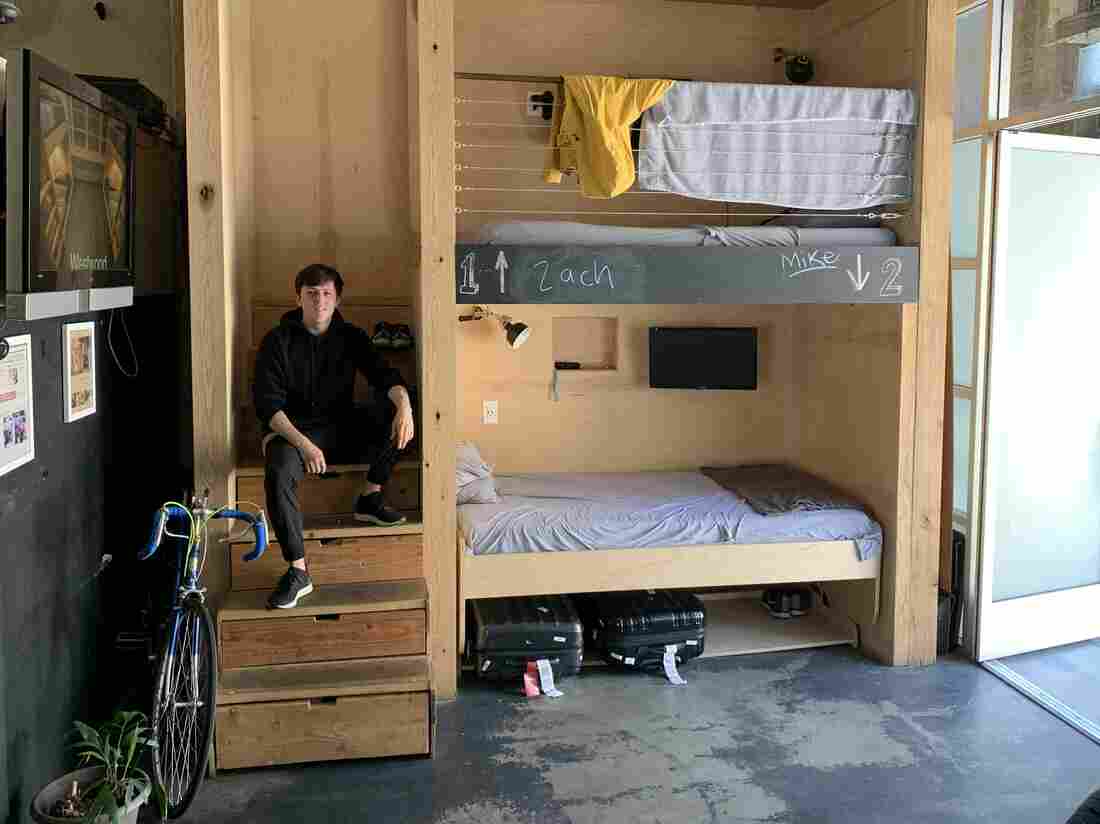
Steven T. Johnson rents a bed at the PodShare in Hollywood, Calif. "When you don't own things, you don't have to keep track of them," he says. "You just show up." Courtesy of Steven Johnson hide caption

toggle caption
Courtesy of Steven Johnson

More young people are leaning into the rental or sharing economy — owning less of everything and renting and sharing a whole lot more. Housing, cars, music, workspaces. In some places, like Los Angeles, this rental life has gone to an extreme.

Steven T. Johnson, 27, works in social media advertising and lives in Hollywood. He spends most of his days using things he does not own.

He takes a ride-share to get to the gym; he does not own a car. At the gym, he rents a locker. He uses the gym's laundry service because he does not own a washing machine.

Johnson doesn't even have an apartment, actually. He rents a bed in a large room with other people who rent beds, for nights, weeks or months at a time, through a service called PodShare. All the residents share a kitchen and bathrooms. Johnson also rents a desk at WeWork, a coworking space.

And he says the only clothes he owns are two versions of the same outfit.

Johnson says he owns so little he's even been able to get rid of his backpack. "I gave that up two months ago," he says.

He says that for him, this lifestyle isn't cumbersome or confusing. "That's what's great," he says. "When you don't own things, you don't have to keep track of them. You just show up."

He's part of a new-ish group of young people. He's educated and owns his own business. He could be considered well off, but he's also, in a way, homeless. By choice.

There are two big reasons for this shift: the price of housing and student loan debt. A little more than a third of millennials currently own homes, a rate lower than Generation X and baby boomers when they were the same age.

But is there something else going on as well? Does Johnson represent a fundamental shift in American capitalism as we know it?

Skyler Wang, a Ph.D. student at UC Berkeley who studies the sharing economy, says even if young people own less and are less enamored with ownership than their parents may be, they still have a lot of stuff — it's just not tangible.

"I talked to a lot of minimalists," Wang says. "They're the type of people who love to couch-surf. They own like 30 things, but ... they hoard digitally. They have tons of photographs. They have thousands and thousands of Instagram posts."

They still live in an economy of stuff — it's just different stuff. It's experiences.

How do businesses deal with this? For starters a lot more companies are getting into rentals. Even Ikea is starting to lease its furniture.

The outdoor chain REI announced recently it's vastly expanding its rental program for things like camping gear. Eric Artz, acting CEO of the company, says this requires a different kind of outreach.

"We're selling joy," he says. "We're selling inspiration when you get out on a trail or go for a bike ride. We're selling the adrenaline buzz at the end of a run and we're just trying to enable that in any way we possibly can."

Juliet Schor, a sociologist at Boston College who studies the rental and sharing economies, says not everyone is in it for the same reasons. Some are doing it just for enjoyment. Some are doing it to move toward transactions that are less corporate and more personal. Others are willing to spend more for convenience.

But a lot rent and share because they're broke and they need to save money.

"I think it's a mistake to characterize them ... with one kind of economic orientation or orientation to money," Schor says.

That makes it really hard to predict whether renting and sharing is our long-term future, or just a fad — even for Johnson, who is totally plugged in to a rental life.

"It's not something that you can do forever, because you do need to have a place that you can genuinely point to and say, this is my home," he says.

(Note: REI and WeWork are among NPR's financial sponsors.)

Let's block ads! (Why?)


https://www.npr.org/2019/04/23/715107132/the-affluent-homeless-a-sleeping-pod-a-hired-desk-and-a-handful-of-clothes

2019-04-23 15:02:00Z
CAIiECd6r63JAN2xltaCg7ce63MqFggEKg4IACoGCAow9vBNMK3UCDCvpUk

US expands probe into air bag failures possibly responsible for up to 8 deaths - Lincoln Journal Star

[unable to retrieve full-text content]

  1. US expands probe into air bag failures possibly responsible for up to 8 deaths  Lincoln Journal Star
  2. US expands probe into air bag failures to 12.3M vehicles  The Associated Press
  3. As air bag probe expands to include 12.3M vehicles, is your car one of them?  NBCNews.com
  4. U.S. expands airbag probe to 12.3 million vehicles  WJW FOX 8 News Cleveland
  5. US expands probe into air bag failures to 12.3 million vehicles  KOMO News
  6. View full coverage on Google News

https://journalstar.com/news/national/us-expands-probe-into-air-bag-failures-possibly-responsible-for/article_4a8849a5-9de5-5091-9624-7fe59ae1fdd7.html

2019-04-23 13:26:00Z
52780275446838