Minggu, 28 April 2019

Chinese electric car maker BYD's first-quarter profit up 632 percent - CGTN

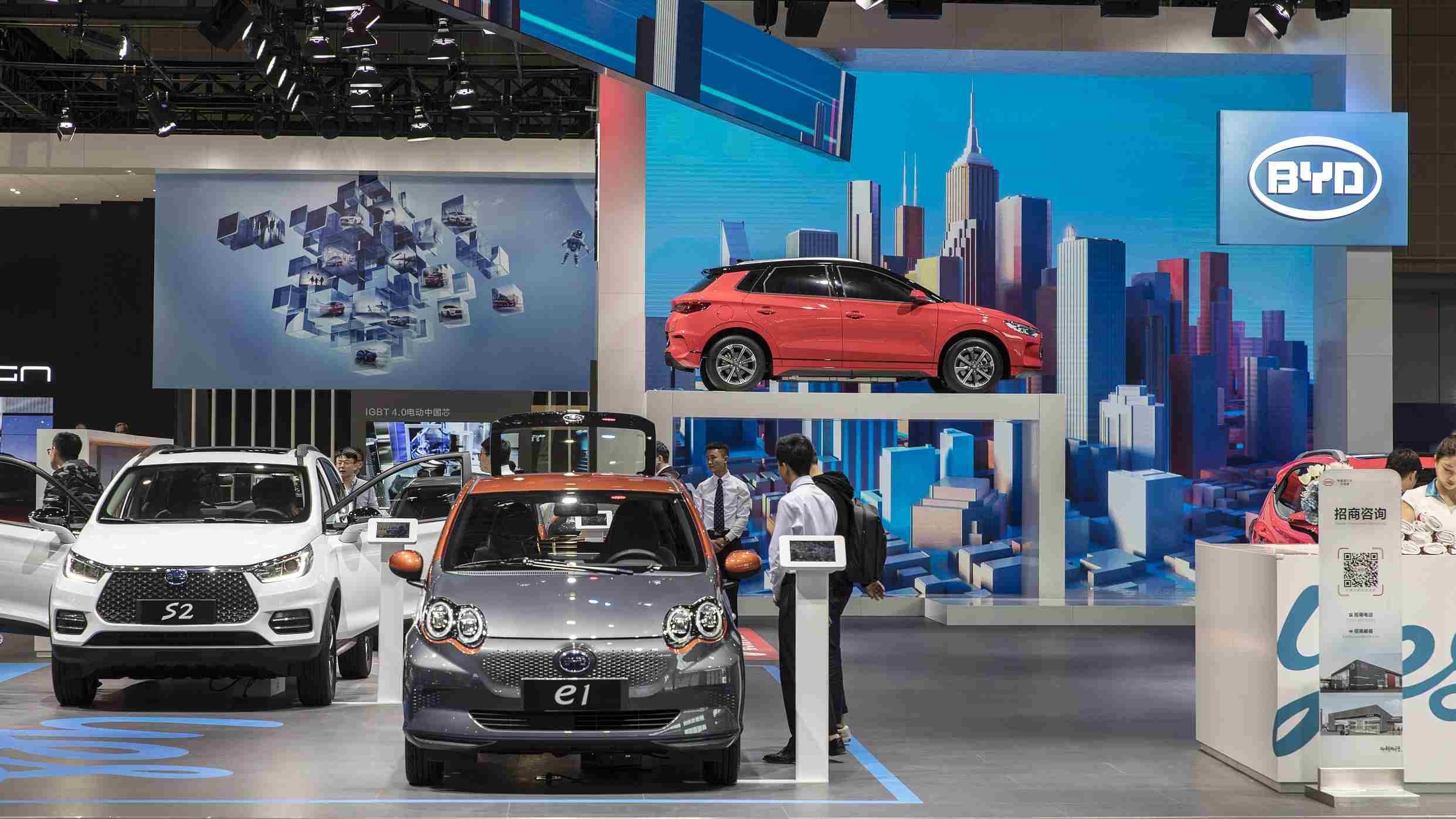
Chinese electric vehicle maker BYD Co Ltd, backed by U.S. investor Warren Buffett, reported on Sunday a 632 percent jump in its first-quarter net profit, buoyed by strong demand for its new energy vehicles.

The Shenzhen-based car and battery maker, which has a joint venture with Daimler AG in China, said last month it expected first-quarter profit to rise by up to nearly 800 percent.

Profit surged to 749.73 million yuan (111.4 million U.S. dollars), up from just 102.4 million yuan a year ago, when its earnings fell sharply due to cuts to subsidies for electric vehicles.

BYD said it expected half-year net profit to rise to 1.45 billion yuan to 1.65 billion yuan, versus 479.1 million yuan in the same period last year.

"New energy vehicles are expected to continue to sell well in the second quarter, and new energy vehicle sales and revenues continue to maintain strong growth," the company said in a stock exchange filing, adding that new passenger and commercial vehicle models will help boost revenue.

China's market for electric cars is booming, but profits in the sector have been squeezed by fierce competition between established firms and rival startups, as well as moves by Beijing to cut subsidies for the market to improve product quality and standards.

The company sold 117,578 vehicles in the first three months this year, up 5.2 percent from a year earlier. BYD, whose popular models include its Tang-series electric cars, has said it aims to sell 650,000 vehicles in 2019.

Overall electric car sales in China jumped 61.7 percent in 2018 to 1.3 million vehicles, according to China's top car industry body China's Association of Automobile Manufacturers (CAAM). It sees electric vehicle sales hitting 1.6 million this year.

China last month raised its standards for electric cars that qualify for subsidies and reduced the amount it is willing to provide to relevant companies.

Let's block ads! (Why?)


https://news.cgtn.com/news/3d3d414e7a4d7a4d34457a6333566d54/index.html

2019-04-28 14:16:27Z
52780279791569

Uber's fresh IPO plans capped off Lyft's brutal first month on the stock market. Here's everything we know since its debut. - Business Insider

Lyft's performance since going public.Lyft's performance since going public.Business Insider/Yutong Yuan
  • Lyft went public one month ago Monday.
  • It's been an awful few weeks for shares since their March 29 debut, falling 35%.
  • Uber, Lyft's main rival, is primed to make its stock-market debut next month.
  • Here's what the last month has shown us about Lyft's early reception and what risks lie ahead.
  • Watch Lyft trade live.

Lyft shareholders haven't had much to cheer about since the ride-hailing company went public in its historic debut one month ago.

With the stock down 20% from its initial pricing and 35% since its opening trade, Lyft's brutal performance has set the tone for its larger rival Uber and a host of other companies to hit the public market this year.

And Uber is weighing on Lyft's stock even before its own debut. Lyft shares fell to a fresh post-IPO low on Friday after Uber updated its S-1 filing with the Securities and Exchange Commission, saying it is now seeking a valuation of up to $90 billion — well below the $120 billion it had previously expected. Lyft shares saw a similar sell-off earlier this month when Uber first filed to go public

Read more: Lyft sinks to new low after Uber files to go public, highlighting Wall Street's competition concerns

But investors have learned more about how the market views Lyft, and where the stock might go from here once Uber begins trading. Here's what we know about short interest, competition, and more in the weeks since Lyft's debut on the public markets.

Exclusive FREE Report: The Self-Driving Car Race by Business Insider Intelligence

Let's block ads! (Why?)


https://www.businessinsider.com/lyft-stock-price-everything-we-know-about-first-month-trading-2019-4

2019-04-28 13:00:36Z
52780278331384

Fidelity and Schwab Customers Can’t Get Vanguard’s Cheapest Funds - Barron's

Photograph by Lost Places

As a longtime Fidelity customer (and former writer for its web site), I’ve long appreciated the company’s customer service and wide array of investment choices. But when I tried to buy the Admiral class shares of a Vanguard mutual fund recently, I was politely told that it wasn’t available—no matter how good a customer I was.

Vanguard, it turns out, is keeping some of its lowest-cost products off the shelves of fund “supermarkets” like Fidelity and Schwab. While investors can purchase most Vanguard mutual funds at these firms, they will have to buy directly from Vanguard if they want the lowest-cost Admiral shares of its actively managed funds.

The situation is an odd one, and it’s a byproduct of changes that Vanguard made last year in its dual-class structure of mutual funds. Vanguard has long had two classes of shares: Investor and Admiral. Investor shares have lower investment minimums and higher expense ratios than Admiral. But Vanguard harmonized the two classes for its index funds last year: It lowered investment minimums for Admiral to $3,000 from $10,000, and started replacing Investor shares with the Admiral class. That, in turn, opened up the Admiral class of index funds to ownership and sales through third-party brokers like Fidelity and Schwab.

But Vanguard left its dual class structure in place for its actively managed funds, reserving the Admiral shares for purchase exclusively from Vanguard. Even if you meet the investment minimums, starting at $50,000, you’ll have to buy directly from Vanguard if you’re a “retail” customer, though advisers can gain access to Admiral through accounts that are custodied elsewhere.

The difference in annual fees can add up. Vanguard High-Yield Tax-Exempt Fund (ticker: VWAHX), for example, is an actively managed municipal bond fund. It has an expense ratio of 0.17% in the Investor class versus 0.09% for Admiral. If you were to invest the minimum $50,000, the extra cost in the Investor class would be $40 a year.

Read our recent cover story: Fidelity Is Thriving. Here’s What It Needs to Keep Thriving.

That isn’t much in additional expenses, but it adds up for larger investments. Plow $300,000 into the Investor class of the fund and the extra cost jumps to $240 per year. For a $1 million portfolio, the additional expense would be $800 more in the Investor class. That doesn’t assume any capital gains or reinvested dividends that would grow the account and magnify the effect of saving a few hundred dollars in annual fees (something Vanguard stresses in much of its marketing materials and fund literature).

Vanguard, of course, has done more than any other fund company to exert downward pressure on fees. Vanguard says it runs funds “at cost,” and it routinely reduces fees when its own costs decline, pressuring other companies to lower fees to stay competitive.

But Vanguard is facing more competition in its core index-fund business. Expense ratios industry-wide have been declining for years. Several firms now sell index funds that beat Vanguard’s prices, including Fidelity’s new suite of zero-fee index mutual funds.

Moreover, Vanguard is still in the business of gathering assets, and it’s trying to keep investors in-house for its services, which have expanded to include more retirement and advisory products, along with more actively managed funds. Maintaining the exclusive rights to sell its low-cost Admiral shares for active funds is one way to prevent firms like Fidelity or Schwab from poaching client assets.

Editor's Choice

“Vanguard is saying, ‘Why should we offer our best priced item on someone else’s shelf when we want investors to stay with us?’” Daniel Wiener, editor of monthly newsletter The Independent Adviser for Vanguard Investors, tells Barron’s.

Brokerage firms, for their part, have scant incentive to make it any easier to buy Vanguard products. Not only does Vanguard compete against their funds, but Vanguard has never paid for fund distribution. Fidelity and other brokerage firms have long chafed at Vanguard’s refusal to pay for distribution. Some fund companies pay more than 0.15% of fund assets to be on Fidelity’s platform, for instance. Those fees are increasingly important to brokerage firms as expense ratios decline and investors migrate out of actively managed funds to low-cost index products.

“Vanguard doesn’t compensate us for the services we provide,” a Fidelity spokeswoman told Barron’s. “That’s why there’s a higher transaction fee for its funds,” she added, referring to the $75 fee that Fidelity charges to buy a Vanguard fund, well above its normal $49.95 rate.

Vanguard, for its part, appears unlikely to budge on making its Admiral-class active funds available at other firms. “There are no plans to do so at this time,” a Vanguard spokeswoman tells Barron’s. And the firm is plowing ahead with new actively managed funds, including one focused on commodities and another on stocks that screen well for environmental, social, and governance factors.

Both are likely to have Admiral shares that are available exclusively from Vanguard.

Write to Daren Fonda at daren.fonda@barrons.com

Let's block ads! (Why?)


https://www.barrons.com/articles/vanguard-lowest-cost-funds-fidelity-retirement-schwab-51556315451

2019-04-28 11:00:00Z
CBMiYmh0dHBzOi8vd3d3LmJhcnJvbnMuY29tL2FydGljbGVzL3Zhbmd1YXJkLWxvd2VzdC1jb3N0LWZ1bmRzLWZpZGVsaXR5LXJldGlyZW1lbnQtc2Nod2FiLTUxNTU2MzE1NDUx0gFmaHR0cHM6Ly93d3cuYmFycm9ucy5jb20vYW1wL2FydGljbGVzL3Zhbmd1YXJkLWxvd2VzdC1jb3N0LWZ1bmRzLWZpZGVsaXR5LXJldGlyZW1lbnQtc2Nod2FiLTUxNTU2MzE1NDUx

Is This a Market Melt-Up? Here Are Some Ways to Tell - Bloomberg

[unable to retrieve full-text content]

Is This a Market Melt-Up? Here Are Some Ways to Tell  Bloomberg

Once again, stocks are hot. Following a drubbing late last year, benchmark indexes have been grinding higher as investors keep piling in, setting *fresh* all-time ...


https://www.bloomberg.com/news/articles/2019-04-28/is-this-a-market-melt-up-here-are-some-ways-to-tell-quicktake

2019-04-28 06:00:00Z
CAIiENssLcTWYzhFf2TqPIv2wLoqGQgEKhAIACoHCAow4uzwCjCF3bsCMIrOrwM

Investors Brace for a Big Week of Insights Into World Economy - Bloomberg

[unable to retrieve full-text content]

Investors Brace for a Big Week of Insights Into World Economy  Bloomberg

The world economy's ability to rebound from its recent soft patch will be tested anew this week as data is released from Washington to Beijing.


https://www.bloomberg.com/news/articles/2019-04-28/investors-brace-for-a-big-week-of-insights-into-world-economy

2019-04-28 04:00:00Z
CAIiEFAnmZeNk73o4D9ZwTt8bj4qGQgEKhAIACoHCAow4uzwCjCF3bsCMIrOrwM

Sabtu, 27 April 2019

Uber will soon join an ugly but exclusive club: Unprofitable companies worth more than $50 billion - CNBC

Dara Khosrowshahi, now CEO of Uber, on July 7, 2016 in Sun Valley, Idaho

Drew Angerer | Getty

When Uber starts trading publicly in the coming weeks, it will join a very exclusive but less-than-desirable club — companies worth at least $50 billion that are losing money.

Of the 110 U.S. companies with a market capitalization of at least $50 billion, only three were unprofitable last year: CVS, General Electric and Qualcomm. And Qualcomm doesn't really count because its loss was the result of a one-time charge for a change in the tax code.

Uber reported an operating loss of $3 billion in 2018 after losing more than $4 billion the prior year. (The company recorded a net profit last year because of $5 billion worth of one-time gains, mostly from selling its Russian and Southeast Asian businesses.)

This is Uber's central challenge as it moves from the cozy confines of the Bay Area, where venture capital and private equity firms fund futuristic projects, to the rigors of Wall Street, populated by more risk averse mutual funds and wealth managers focused on financial performance. The latter group has never seen anything like Uber — a company that's already valued as a screaming success even though the business model remains very much a work in progress.

On Friday, Uber set the pricing range of its upcoming IPO of $44 to $50, giving it a market cap of $83.8 billion at the high end. That would make it the 65th most valuable company in the U.S., just behind DowDuPont and in front of U.S. Bancorp, which generated net income last year of $3.8 billion and $7.1 billion, respectively.

"If you're wrong on this and you're paying a sky-high valuation, truly look out below," said Brian Yacktman, chief investment officer of YCG Investments, which manages about $700 million and counts Alphabet and Facebook among the top holdings in its mutual fund. "When you can buy a business at a similar market cap that's currently producing cash flow with much more certainty of outcome, why not take that instead?"

To buy or not to buy

Yacktman sees the value in Uber as a service. He knows it saves time, makes payments easy and provides a much more comfortable ride than your typical cab. Food delivery also makes perfect sense, given there's a huge fleet of cars on the streets.

But Yacktman just doesn't get the investment pitch.

Riders are cost-sensitive and have choices, whether it's Lyft (whose stock is well below its IPO price from last month), a taxi or public transportation. On the flip side, drivers have to make enough money to stay on the platform while also paying for gas and maintenance. After doing what it can to make both riders and drivers happy, and spending the money necessary to run the platform, Uber doesn't have much money left for itself.

Uber has a metric called core platform contribution margin, which is the percentage of revenue left after "direct expenses." That number came in at 9% of revenue for 2018, and that's before accounting for all the investments in emerging products. In the first quarter of 2019, the number is turning south, with Uber expecting a negative margin of between 4% and 7% because of competition and spending on Uber Eats, the food delivery business.

"I'd rather buy one of the host of profitable companies showing me the money now and take a wait-and-see approach with Uber to determine if this is a sustainable profitable business model," said Yacktman.

Large-cap companies that are losing money today are being punished by the market. CVS shares have plunged 22% in the past year, while GE has lost 31%.

Source: CNBC

Uber has a very different story to tell than those two companies, which are stuck in legacy markets and struggling to find opportunities for growth. Only a decade old, Uber is pioneering a new industry and working towards a future of self-driving cars, all while growing 42% last year to over $11 billion in revenue.

Uber's vision is to build global platform that includes ride-sharing in its current form, a continued expansion of Uber Eats and with a whole lot more.

There's Uber Freight, which connects trucking companies with businesses that ship large amounts of goods, autonomous vehicles, drone delivery and Uber Elevate aiming to address "air transportation within cities." Uber also acquired Jump Bikes, which currently has a network of e-bikes in 20 cities, and the company offers electric scooters in eight cities.

For Uber, it all adds up to an addressable market that the company says is in the many trillions of dollars. CEO Dara Khosrowshahi says at the beginning of the video for the online roadshow that the company's "mission is to ignite opportunity by setting the world in motion" and that it's "changing the way people and things move from point A to point B."

Nelson Chai, Uber's finance chief, follows by telling investors that the company is "setting the foundation for attractive long-term margins."

But it's an ambitious plan that requires decades — not years — of investment and far more capital than the $9 billion or so the company is seeking to raise in its IPO. The bet for a public investor is that eventually Uber's experimental projects turn into real businesses and the company will be far enough ahead of any potential competition to have pricing power.

"With Uber, you have the potential to create an ecosystem premium," said Eric Barden, president of Barden Capital in Austin, Texas. "If that's the case, you can be more constructive about future profitability."

Barden has no plans to invest in Uber, because he sees too many variables and risks to that kind of valuation. But he also recognizes that the public market investing landscape has changed in recent years to wildly favor growth investors and that a cash-burning machine like Uber can't be dismissed.

Source: CNBC

Amazon and Netflix are both profitable but just barely. Amazon's net profit margin of 4.3% last year ranked 98th amount the 110 most valuable companies, and Netflix's 7.7% margin was 86th.

Yet, Amazon is up 542% in the past five years, and Netflix has gained 717%. The S&P 500, meanwhile, has climbed just 58% over that stretch.

"Old valuation metrics aren't always applicable anymore," said Barden, who's an investor in both Amazon and Netflix. "It's hard to make money playing the undervaluation arbitrage."

Subscribe to CNBC on YouTube.

Let's block ads! (Why?)


https://www.cnbc.com/2019/04/27/uber-one-of-only-3-unprofitable-companies-worth-more-than-50-billion.html

2019-04-27 18:22:10Z
52780278331384
Uber will soon join an ugly but exclusive club: Unprofitable companies worth more than $50 billion - CNBC

Dara Khosrowshahi, now CEO of Uber, on July 7, 2016 in Sun Valley, Idaho

Drew Angerer | Getty

When Uber starts trading publicly in the coming weeks, it will join a very exclusive but less-than-desirable club — companies worth at least $50 billion that are losing money.

Of the 110 U.S. companies with a market capitalization of at least $50 billion, only three were unprofitable last year: CVS, General Electric and Qualcomm. And Qualcomm doesn't really count because its loss was the result of a one-time charge for a change in the tax code.

Uber reported an operating loss of $3 billion in 2018 after losing more than $4 billion the prior year. (The company recorded a net profit last year because of $5 billion worth of one-time gains, mostly from selling its Russian and Southeast Asian businesses.)

This is Uber's central challenge as it moves from the cozy confines of the Bay Area, where venture capital and private equity firms fund futuristic projects, to the rigors of Wall Street, populated by more risk averse mutual funds and wealth managers focused on financial performance. The latter group has never seen anything like Uber — a company that's already valued as a screaming success even though the business model remains very much a work in progress.

On Friday, Uber set the pricing range of its upcoming IPO of $44 to $50, giving it a market cap of $83.8 billion at the high end. That would make it the 65th most valuable company in the U.S., just behind DowDuPont and in front of U.S. Bancorp, which generated net income last year of $3.8 billion and $7.1 billion, respectively.

"If you're wrong on this and you're paying a sky-high valuation, truly look out below," said Brian Yacktman, chief investment officer of YCG Investments, which manages about $700 million and counts Alphabet and Facebook among the top holdings in its mutual fund. "When you can buy a business at a similar market cap that's currently producing cash flow with much more certainty of outcome, why not take that instead?"

To buy or not to buy

Yacktman sees the value in Uber as a service. He knows it saves time, makes payments easy and provides a much more comfortable ride than your typical cab. Food delivery also makes perfect sense, given there's a huge fleet of cars on the streets.

But Yacktman just doesn't get the investment pitch.

Riders are cost-sensitive and have choices, whether it's Lyft (whose stock is well below its IPO price from last month), a taxi or public transportation. On the flip side, drivers have to make enough money to stay on the platform while also paying for gas and maintenance. After doing what it can to make both riders and drivers happy, and spending the money necessary to run the platform, Uber doesn't have much money left for itself.

Uber has a metric called core platform contribution margin, which is the percentage of revenue left after "direct expenses." That number came in at 9% of revenue for 2018, and that's before accounting for all the investments in emerging products. In the first quarter of 2019, the number is turning south, with Uber expecting a negative margin of between 4% and 7% because of competition and spending on Uber Eats, the food delivery business.

"I'd rather buy one of the host of profitable companies showing me the money now and take a wait-and-see approach with Uber to determine if this is a sustainable profitable business model," said Yacktman.

Large-cap companies that are losing money today are being punished by the market. CVS shares have plunged 22% in the past year, while GE has lost 31%.

Source: CNBC

Uber has a very different story to tell than those two companies, which are stuck in legacy markets and struggling to find opportunities for growth. Only a decade old, Uber is pioneering a new industry and working towards a future of self-driving cars, all while growing 42% last year to over $11 billion in revenue.

Uber's vision is to build global platform that includes ride-sharing in its current form, a continued expansion of Uber Eats and with a whole lot more.

There's Uber Freight, which connects trucking companies with businesses that ship large amounts of goods, autonomous vehicles, drone delivery and Uber Elevate aiming to address "air transportation within cities." Uber also acquired Jump Bikes, which currently has a network of e-bikes in 20 cities, and the company offers electric scooters in eight cities.

For Uber, it all adds up to an addressable market that the company says is in the many trillions of dollars. CEO Dara Khosrowshahi says at the beginning of the video for the online roadshow that the company's "mission is to ignite opportunity by setting the world in motion" and that it's "changing the way people and things move from point A to point B."

Nelson Chai, Uber's finance chief, follows by telling investors that the company is "setting the foundation for attractive long-term margins."

But it's an ambitious plan that requires decades — not years — of investment and far more capital than the $9 billion or so the company is seeking to raise in its IPO. The bet for a public investor is that eventually Uber's experimental projects turn into real businesses and the company will be far enough ahead of any potential competition to have pricing power.

"With Uber, you have the potential to create an ecosystem premium," said Eric Barden, president of Barden Capital in Austin, Texas. "If that's the case, you can be more constructive about future profitability."

Barden has no plans to invest in Uber, because he sees too many variables and risks to that kind of valuation. But he also recognizes that the public market investing landscape has changed in recent years to wildly favor growth investors and that a cash-burning machine like Uber can't be dismissed.

Source: CNBC

Amazon and Netflix are both profitable but just barely. Amazon's net profit margin of 4.3% last year ranked 98th amount the 110 most valuable companies, and Netflix's 7.7% margin was 86th.

Yet, Amazon is up 542% in the past five years, and Netflix has gained 717%. The S&P 500, meanwhile, has climbed just 58% over that stretch.

"Old valuation metrics aren't always applicable anymore," said Barden, who's an investor in both Amazon and Netflix. "It's hard to make money playing the undervaluation arbitrage."

Subscribe to CNBC on YouTube.

Let's block ads! (Why?)


https://www.cnbc.com/2019/04/27/uber-one-of-only-3-unprofitable-companies-worth-more-than-50-billion.html

2019-04-27 18:09:28Z
52780278331384